Rohan's search for the missing men
The InvincibleRohan's search for the missing men is the decisive transition from organized expedition to solitary confrontation with Regis III's unknown danger. After the failures and deaths of the exploratory parties, Rohan accepts Horpach's private proposal to enter the ravine alone, without a helmet, vehicles, or weapons, using a silicon breathing apparatus and a carefully staged diversion. The mission is meant to establish whether anyone survived, but its deeper significance lies in the kind of knowledge it demands: not an explanation assembled safely from instruments and reports, but direct exposure to the cloud, the battlefield, and the bodies it has left behind.
Causes and Mission Design
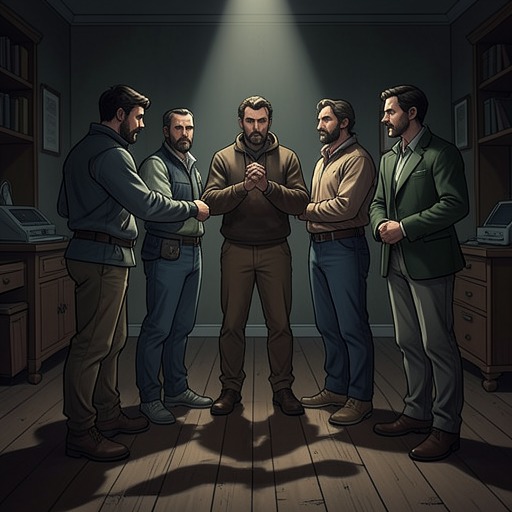
The search begins when Horpach concludes that the expedition cannot simply leave Regis III without certainty about the missing personnel. He tells Rohan that he could not publicly ask for a volunteer, because he has no right to demand such a sacrifice, yet the situation has narrowed to a single possibility: one man may be able to enter the dangerous zone and return without the equipment that would attract or provoke the cloud. Rohan understands the unspoken pressure between them and says that he will go. Horpach immediately rejects the idea that Rohan's decision should be treated as a normal order, emphasizing that the choice remains between them.
Horpach's plan is both technical and sacrificial. Two unmanned jeeps are to draw the cloud away and be destroyed, while a third carries Rohan as close as possible to the northern edge of the plateau. He is then to descend on foot into the upper ravine, where survivors might have taken shelter. His oxygen supply is calculated to last eighteen hours, and the expedition has photograms of the ravine and surrounding terrain. The proposed route avoids the paths used by earlier expeditions and relies on a descent from the cliffs rather than a direct approach through the most dangerous ground. The design gives the mission a rational procedure, but the possibility that Rohan is being sent to ease Horpach's conscience remains an inescapable moral shadow.
Departure and the Ravine
At dawn, the first two jeeps pass through the Invincible's force field and move down the ramp. Rohan rides on the rear step of the third, wearing a jumpsuit without a helmet or protective goggles and breathing through a small oxygen mask. His equipment is chosen to minimize the metal that might draw the cloud: four ampoules, nutritional tablets, a Geiger counter, a magnetic sensor, a compass, a microphotogram map, plastic rope, and a microtransmitter sewn into his collar. Even the wires in his hair and the transmitter's regular pulse form part of the mission's fragile technical margin.
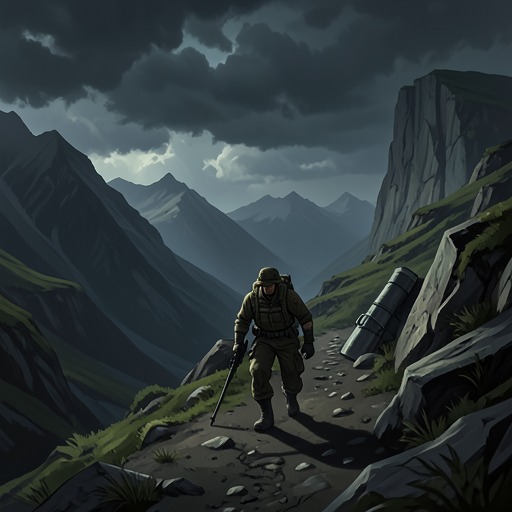
The journey ends at mile twenty-four when the jeep rears up on the scree and can go no farther. Rohan jumps clear, receives his coordinates, and continues on foot. The map places him roughly half a mile from the ravine's rim, but the sides are covered with metal undergrowth, making a direct descent impossible. He chooses a longer route, calculating the hours required to reach the selected descent point and return. The mission suddenly appears irrational: a heroic gesture that may sacrifice him without changing the fate of the missing men. After his anger subsides, he sets a limit for himself and continues, regulating his pace because exertion will consume oxygen more rapidly.
The descent exposes the physical character of the planet's threat. Black bushes cover the slopes, their metallic growths close enough to brush his suit, while small puffs of smoke rise and hover above them. Rohan moves with his attention fixed on either side of the narrow ridge. Near noon, loose scree gives way beneath him and throws him down the slope, dislodging his oxygen mask. He has just seen a possible survivor below and is preparing to run after the figure when an instinctive warning makes him flatten himself against the rocks.
Encounter with the Black Cloud
The black mechanical cloud descends over Rohan with an expanding hum that moves through every register from a high hiss to bass vibrations. A twisting limb reaches down, resembling the mouth of a dark, glistening whirlwind. The cloud touches the air around his face and grazes his suit, immersing him in shadow before withdrawing and dissolving into the metallic undergrowth. Rohan remains motionless, uncertain whether the attack has already destroyed his identity as it destroyed the minds of others.
His terror is specifically the fear of annihilated memory. He imagines waking without knowing who he is, how he arrived, or what he should do, and the thought drives him abruptly upright. His ability to formulate that fear proves that he has survived. The moment changes the mission's value: the cloud is no longer merely a distant cause of catastrophe but an immediate force that has tested him and, apparently, failed to erase him. Rohan follows the footsteps of the person glimpsed from the ridge, though the figure disappears among the rocks.
The danger is framed by the expedition's incomplete knowledge. The grave-sounder had established that a dead brain could preserve the last contents of consciousness, while later examination of a survivor showed an extraordinary annihilation of personality rather than ordinary amnesia. The apparent images in recorded engrams were also clarified as still photographs of consciousness, not proof that the people in them had been moving. Against that uncertain archive, Rohan's encounter supplies a bodily experiment: he has been exposed to the cloud and remains himself, but he still cannot infer what happened to the others or whether his immunity will last.
Bodies, Evidence, and the Battlefield
Rohan's search eventually produces physical evidence rather than a living rescue. Near a cave, he notices a dry rusty streak on the exceptionally white boulders and follows the blood trail to a narrow shaft. At its bottom he finds Bennigsen's head, with empty eye sockets and bared teeth; the geologist is trapped vertically between two boulders. Rohan recognizes him by his gold-rimmed spectacles, removes the scientist's identification tag, and covers the grave with a slab of rock. He later regrets failing to measure the body's radioactivity, since the reading might have indicated whether Bennigsen had been near the atomic clash, but he refuses to reopen the grave.
The discovery also changes Rohan's understanding of the search itself. He had believed that he had combed the area thoroughly, yet chance reveals the overlooked shaft and leads him to the first missing man. The blood trail runs toward the presumed battlefield, then turns aside, showing how far Bennigsen traveled after being wounded. Its extent makes his survival journey more remarkable while offering no final explanation of what pursued or injured him.
Further along, Rohan finds the remains of an arctan lying broken on its side, apparently struck by a Weyr blast. Nearby, Regnar sits dead against a boulder, his helmet blackened by soot and his gun still hanging from his hand. Decay has distorted his face, but Rohan identifies him by the broad geological bag on his shoulder. The Geiger counter detects the rare-earth isotopes characteristic of a Weyr hit. Rohan takes the bag, removes Regnar's monogram without touching the corpse, and builds a mound of stones over the body.
Regnar's death leaves a puzzle rather than a solution. The scene suggests that he fired at the robot, but Rohan cannot determine whether the arctan attacked Regnar or Bennigsen, nor whether a person suffering from the strange personality annihilation could defend himself during an attack. He considers taking the Weyr, which may still be loaded, but the thought comes too late. Instead, he removes a still-full oxygen tank from Regnar's apparatus and abandons his own empty one. The dead man thereby extends the searcher's life, and Rohan experiences the exchange as a final material return from someone he could not save.
The Unresolved End of the Search
Rohan continues toward the rock gateway while fatigue nearly immobilizes him. Radioactivity rises as he approaches the battlefield: surfaces show the cracked glaze of thermal impact, and some boulders are covered with frozen bubbles where the rock boiled. The gateway has collapsed into a basin of transformed sediment and lava, while the black metal undergrowth has been reduced to incinerated rags. The landscape makes the scale of the earlier violence visible, yet it does not identify the fourth missing man.
Near another gateway, Rohan finds an aluminum breathing-apparatus regulator and a headless corpse crushed against the rocks. Beside it lies an undamaged, battered Weyr, which he takes. The body cannot be identified. By then the light on the ravine's eastern slope is turning red, and Rohan faces the central ethical decision of the mission: he has survived, gathered evidence, and confirmed three deaths, but he came to obtain certainty about the remaining man. Regnar's oxygen gives him six more hours, although the coming night, the cloud, and his exhaustion make further progress extremely dangerous. The search therefore ends not with rescue or explanation, but with Rohan still planning what to do next, suspended between the rational duty to return and the moral refusal to accept an unverified death.
The event's force comes from that unresolved balance. Regis III's geology records an ancient sequence in which land life disappeared while metallic strata accumulated, but the evidence does not convert the planet into a humanly legible crime scene. The black cloud's apparent organization may be an inanimate process of self-organization rather than hostile intention; nevertheless, it has produced unmistakable human losses. Rohan's descent makes that contradiction personal. He searches for people, finds only graves and damaged machines, and survives an encounter that attacks not simply the body but the continuity of the self. His mission transforms missing persons into witnesses, forensic traces, and a question that the available evidence still cannot close.